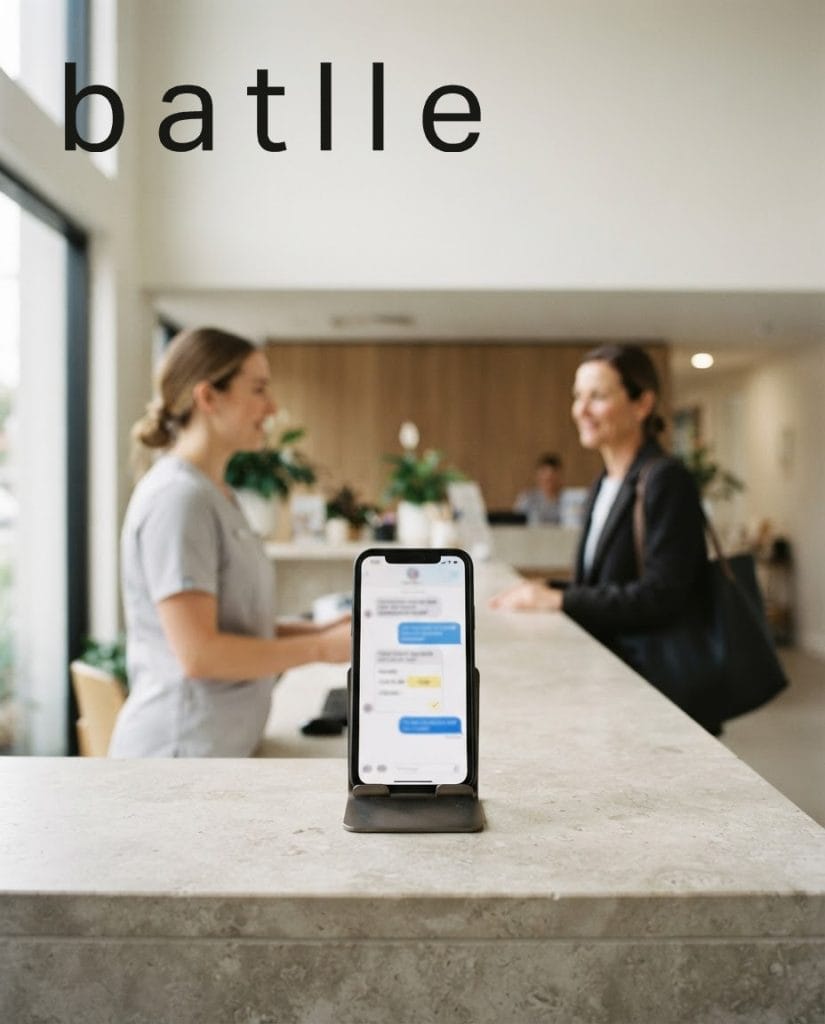
It's eleven in the morning at a dental clinic. The receptionist is ringing up a patient, another is waiting for their next appointment, and the phone rings for the third time in five minutes. She answers it, asks for a moment, and returns to the counter. When she finally calls back, the caller has already booked an appointment at another clinic.
The same scene is repeated in physiotherapy clinics and beauty centers. It's not a problem of attention or willingness: it's that the same person can't properly attend to the person in front of them and, at the same time, handle someone who writes or calls to request an appointment. In this article, we explain how a WhatsApp appointment system works for clinics and what changes to the daily routine at reception.
The problem: the schedule depends on someone being free.
In most clinics, making an appointment still depends on someone being available to answer. This has three consequences you know all too well:
- Unanswered calls and messages During peak working hours, at lunchtime and outside of opening hours, which is precisely when many patients have time to make an appointment.
- Empty spaces because a patient forgets the appointment or doesn't notify that they can't come, and nobody has time to call to remind them or to offer that slot to someone else.
- A team that runs between the counter, the phone and the clinic's WhatsApp, with the feeling of not being able to do everything.
Every missed or missed appointment is wasted consultation time. And every patient waiting for an answer that never comes is a patient who may end up going elsewhere.
What does a dating agent do on WhatsApp?
A booking agent is an AI assistant that handles appointment requests on the clinic's WhatsApp, at any time, according to the rules you set. In practice, it performs four tasks:
- Make an appointment. The patient writes, the agent asks what they need (a check-up, a physiotherapy session, a specific treatment), checks the available slots in the schedule, and suggests options. When the patient chooses, the appointment is registered.
- Remember the appointment. Before the visit, send a reminder via WhatsApp and ask for confirmation.
- Manage changes and cancellations. If the patient cannot come, the agent offers another date and frees up the slot for someone else to fill.
- Answer the usual questions. Schedules, address, how to get there, what to bring to the first visit, or how to prepare for treatment.
When the conversation requires a person (an emergency, a clinical question, an unusual case), the agent indicates this and passes the notification to the team to handle it.
How the day-to-day life of the reception changes
The agent does not replace reception: he removes the repetitive part so that it can dedicate itself to what a person needs.
Fewer interruptions at the counter
Appointment requests received via WhatsApp are handled without anyone having to interrupt what they're doing. The patient in front receives undivided attention.
Appointments also available outside of regular hours
Anyone who writes at ten o'clock at night to request an appointment receives an immediate response with a specific date, instead of waiting until the next day.
A more organized schedule
Reminders and change management help ensure that gaps that are freed up are filled again, instead of discovering the absence when the patient has already failed to appear.
What type of centers does it fit?
This agent fits any business that works by appointment and receives many requests by message or phone:
- Dental clinics, with periodic reviews, treatments in several sessions, and patients who need to change the date.
- Physiotherapy centers, where patients attend weekly sessions and last-minute changes are frequent.
- Beauty salons, with treatments of different durations and booths or professionals that must be properly assigned.
We also apply it in medical consultations, restaurants and professional offices, adapting the questions and rules to each case.
Control and privacy
You decide what the agent can and can't do: what services they offer, how far in advance they schedule appointments, how long each visit lasts, and when to transfer the conversation to another person. It connects with your existing calendar (for example, Google Calendar) to ensure you always work with available slots.
In a clinic, patient data deserves special care. That's why the agent only asks for the information necessary to schedule the appointment and doesn't delve into clinical matters: those are always handled by the team.
How do we get it up and running?
At Batlle we have 35 years of experience in marketing and communication, and we work with AI agents using the same method:
- Conversation. Tell us how your schedule works today, what services you offer, and where most appointments are lost.
- Proposal. We sent you a fixed-price proposal, with an implementation fee and a monthly fee.
- Start-up. We configure the agent with your services, schedules, and rules, and test it with you before opening it to patients.
- Follow-up. We review with you how it works and adjust it when something changes in the clinic.
Schedule a meeting
If your clinic or center is overwhelmed by phone calls and WhatsApp messages, and you're constantly seeing patients in front of you, let's talk. In our initial meeting, we'll review your workflow and explain how an agent could fit into your schedule.
Schedule a meeting with us: Write "meeting" in the form message and we'll call you to set a date.
If you'd prefer to see it in action first, Try our agent via WhatsApp by texting "Hola Batlle" to 682 414 644. And in our AI agents page You have the rest of the agents that we prepare for companies.
 Español
 Català
 Français
 English (UK)