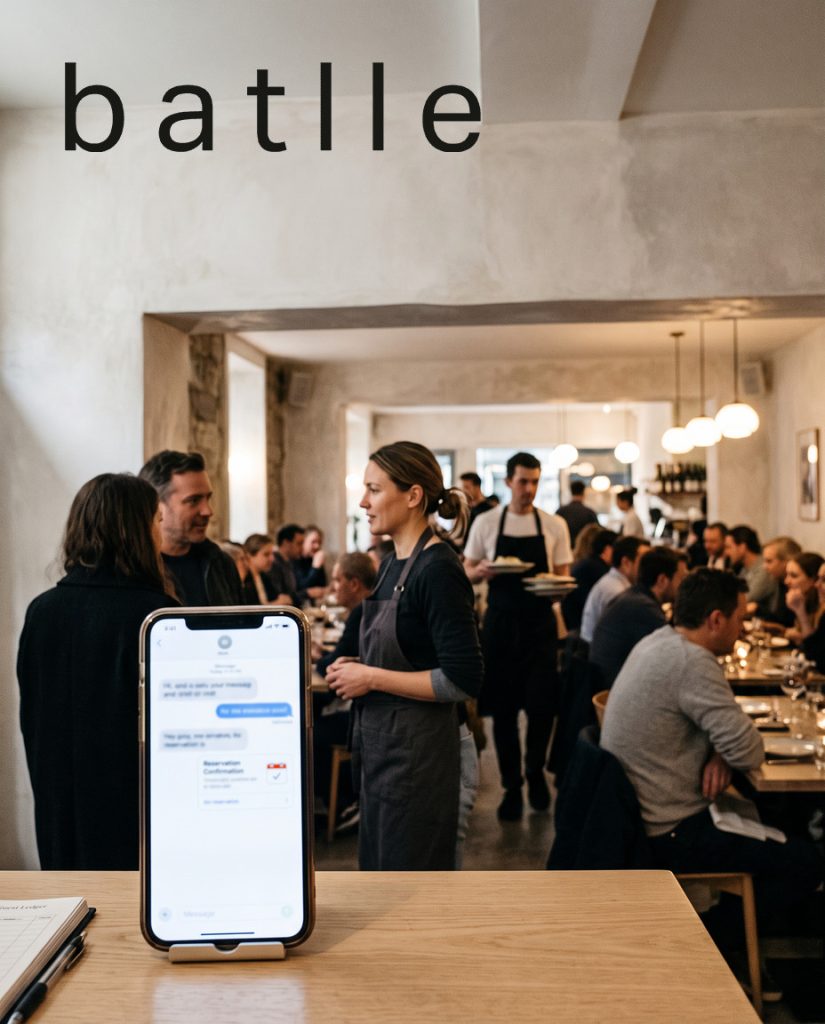
The AI-powered automation for restaurants It involves an agent handling reservations received via WhatsApp while the team serves: reading the message, checking available tables, suggesting a time, confirming the reservation, sending reminders, and releasing the table if someone cancels. The dining room continues serving the customer at the front of the table.
Friday, 9:40 p.m. The dining room is packed, the kitchen is buzzing with orders, and the restaurant's cell phone is vibrating next to the register: «Hello, do you have a table for six tomorrow at nine?» No one can answer. By the time someone checks it, after midnight, that customer has already made a reservation at the place across the street.
That message wasn't lost for lack of effort. It was lost for lack of manpower. And responding at any hour, with complete availability, is precisely the kind of work an AI agent does best.
Why does a restaurant lose reservations in the middle of service?
Because reservations come in when the team is busiest. Someone wanting a table for Saturday writes on Friday night, from their sofa or another restaurant, just as your waiter is carrying three dishes in one hand and the bill for table eight in the other. The phone rings, WhatsApp messages pile up, and the reply is late or never comes.
Then there are the tables that are reserved and no one uses. On a Saturday at 9:30 p.m., an empty table for four has gone unsold twice: once to someone who didn't show up, and again to someone who couldn't make the reservation because they were on the waiting list. It's almost never malicious. It's an oversight, a change of plans, a cancellation message the customer never got around to sending.
Both problems stem from the same source: no one on the team can be monitoring their phone and the room simultaneously. Nor should they be.
How AI automation works for restaurants, step by step
The agent works through the restaurant's WhatsApp group and follows the rules you set: shifts, number of tables, maximum group size, closing days. This is how a reservation works from start to finish:
- Receive the message at any time and understands what is asked, even if it arrives written in haste: «tomorrow night 6 people terrace?».
- Check availability of that day and that shift.
- It proposes an alternative If the requested time slot is full: «We don't have any at 9:00 PM, but at 9:45 PM there's a table for six on the terrace. Shall I reserve it for you?».
- Confirm your reservation with name, day, time and number of people, and leave it noted where you manage it.
- Send the reminder on the same day and asks the customer to confirm or cancel.
- Clear the table If the customer cancels and notifies the room so that it can be offered again.
Between bookings, the agent also answers common customer questions, always using the information we've provided: kitchen hours, whether there's a daily menu, if dogs are allowed, or if the terrace is covered in winter. These are just examples; they answer questions based on their knowledge. And when they don't know the answer, they don't make it up: they pass the conversation on to a member of the team.
What changes in daily life with AI agents?
The first thing you notice is the silence. The mobile phone ceases to be an alarm that no one answers and becomes a channel that works on its own. The manager arrives on Tuesday at 12:00 and, instead of twenty pending messages and two audio recordings, finds the day's reservations confirmed and the cancellations already resolved.
The second thing is service. Nobody leaves a table half-served to answer the phone, and the customer in front of you receives your full attention. It's the same principle we apply in the WhatsApp appointment agent for clinicsThe receptionist shouldn't have to choose between the phone and the person waiting at the counter.
And third, the reminder. A midday message with the evening reservation gives the customer a chance to let you know if they can't make it, and gives you the opportunity to offer that table again in time. AI agents don't magically fill the dining room, but they do close the gap through which tables are being lost: the message no one reads.
And what about the personal service at the restaurant?
It's still yours. The agent writes in the same tone as your restaurant, neither more formal nor more friendly than you are, and only does what you've decided he should do. If your restaurant uses the informal "tú" with customers, then use it. If it needs to be said that the kitchen closes at 10:30 p.m. on Sunday nights, say it directly, without beating around the bush.
Requests requiring discretion are passed on to a designated person who handles the entire discussion: a company dinner for twenty people, a birthday cake that needs to be coordinated with the kitchen, an allergy that should be discussed calmly. The agent filters the volume and ensures your team can focus on what truly needs to be handled by someone within the company.
Furthermore, you can see all the conversations. You can review the replies, correct responses, or change rules, and the agent will apply the changes in the next message. Well-designed AI automation doesn't alienate the customer; it actually provides faster responses.
What you need to get AI automation up and running in your restaurant
Less than it seems. We need to know how you currently handle bookings (notebook, spreadsheet, booking software, or calendar), what the venue's rules are, and what questions customers ask most frequently. With that information, we'll develop the booking system, test it with you before launching it to the public, and fine-tune it during the first few weeks.
At Batlle, a digital marketing agency in Barcelona, this is how we work:
- Conversation: We understand how your restaurant works and where reservations are being lost.
- Proposal closed: an implementation fee and a monthly fee, no surprises.
- Start-up: We connect the agent with your WhatsApp and with the tool where you manage reservations, if it allows it.
- Follow-up: We review the conversations with you and fine-tune whatever is needed.
If you want to see what other tasks can be delegated to an agent, in our guide to automating tasks with AI We reviewed the entire catalog. And if you also sell online, the WhatsApp chatbot for online stores solve the same problem at the other counter.
Frequently asked questions about AI automation for restaurants
Does the agent replace the restaurant's phone?
No. The phone is still available for those who prefer to call. The agent handles WhatsApp, which is how many customers contact us, freeing up the team to manage the waiting room and incoming calls.
What happens if a customer asks for something the agent doesn't know?
She says it naturally and passes the conversation on to a member of the team, with all the relevant information. She doesn't improvise answers about dishes, prices, or allergens that you haven't already told her about.
How much does a restaurant reservation agent cost?
It depends on how you work today and what it needs to be connected to. It works with an implementation fee and a monthly fee, and we'll give you a fixed-price proposal after our initial conversation.
A restaurant's success depends on the dining room, not on mobile phones. Reservations can be handled automatically.
Request a demo
Go to our agent page, open the chat bubble, and ask them anything you want: how to book a table for six, what they would do in case of a cancellation, or what they say when they don't know something. Our own agent will answer you.
 Español
 Català
 Français
 English (UK)