
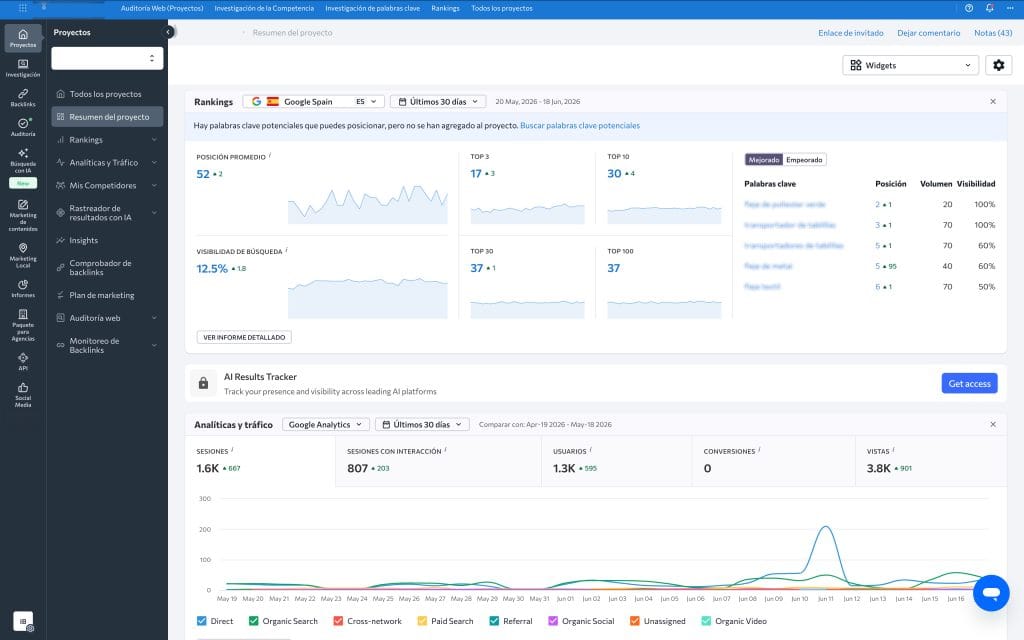
There's something that, in our daily work as an SEO and GEO agency in Barcelona, a digital marketing and web development agency, continues to give us the same satisfaction as the first time: seeing a client's website start to climb the Google rankings. A keyword that was on page 3, then on page 2, then in the top results. That progress doesn't happen by chance.
SEO: a never-ending job
SEO —Search Engine Optimization— It's one of those jobs that demands a constant state of learning. Search algorithms aren't static: Google updates its core algorithms several times a year, and each change can reshuffle the landscape. For a web positioning agency, staying up-to-date isn't optional; it's part of the job.
But SEO isn't just about technique. It's also about constant research: understanding what the user is really looking for behind each query, the intent behind each keyword, and what content best addresses that need. Technical optimization—page load speed, URL structure, structured data, internal architecture—is the foundation. On top of that foundation, a content strategy is built that answers real questions, generates subject authority, and attracts qualified traffic sustainably.
GEO: the new challenge of positioning in the age of AI
And now we have to add a completely new layer: the GEO (Generative Engine Optimization), the discipline that works on search engine optimization using artificial intelligence. ChatGPT, Perplexity, Google AI Overviews… more and more people are getting answers directly from these tools, without even clicking on any results. The question is no longer just Do I appear in Google search results?, but Do language models cite me when someone asks about my sector?
What's fascinating—and challenging—is that the logic isn't exactly the same as in traditional SEO. LLMs prioritize subject authority, the semantic structuring of content, and the sources others cite. Understanding how they build their "knowledge" about a sector combines classic SEO with something akin to digital public relations. It's new territory, and at Batlle, we're exploring it with the same rigorous methodology we apply to traditional SEO.
Working on GEO involves, among other things, structuring content so that AI models can extract clear and precise answers, building a consistent presence in external sources of authority, and developing a coherent brand narrative that LLMs associate with topics relevant to your business.
What is constant in all of this
Despite all the changes, the fundamentals remain the same. The same rigorous work: technical audits, competitor analysis, keyword research, content architecture, and authority building. The pillars of good SEO don't change. What changes is the ecosystem to which they must adapt and the speed at which that ecosystem evolves.
That's why at our digital marketing and web development agency in Barcelona, we combine strategic vision with meticulous technical execution. Every project begins with an honest assessment of the current situation and a clear roadmap toward the objectives. And it's built with patience, because SEO and GEO are long-term disciplines, not sprints.
The results that matter
And when we see the results—rankings rising, organic traffic growing, a client telling us «"They're calling us because of a Google search."»— That combination of method, constant curiosity, and a job well done makes perfect sense. That's the satisfaction that drives us.
Do you want to improve your company's website ranking in Barcelona? Tell us where you are and we'll explore the opportunities together.
 Español
 Català
 Français
 English (UK)